When you click on links to various merchants on this site and make a purchase, this can result in this site earning a commission. Affiliate programs and affiliations include, but are not limited to, the eBay Partner Network.
This edition corresponds to the opera’s original 1862 version, which premiered at the Imperial Italian Theatre in St. Petersburg on November 10, 1862. The printed cast list names the original St. Petersburg performers, including Caroline Barbot as Donna Leonora, Francesco Graziani as Don Carlo, Enrico Tamberlick as Don Alvaro, Constance Nantier-Didiée as Preziosilla, and Achille De Bassini as Fra Melitone. The score opens with the original short “Preludio,” rather than the extended “Sinfonia” Verdi composed when he substantially revised the opera for its 1869 Milan revival.
The edition is undated, but its bibliographic characteristics—Léon Escudier’s 21 rue de Choiseul imprint, plate number L.E. 2205, the original St. Petersburg cast, the Preludio, and a final numbered page of 322—correspond to an Escudier edition cataloged as approximately 1862–1863. It therefore preserves the opera in its rarely encountered original form, preceding the familiar 1869 revision that replaced the prelude with a full overture and substantially altered the opera’s conclusion. A matching bibliographic description records two preliminary leaves and 322 pages and dates the issue to 1862/63, while modern online score catalogs sometimes group plate L.E. 2205 under the revised version. For that reason, this listing describes it conservatively as an early Escudier edition of the original 1862 version rather than making an unqualified first-edition claim. Edition and revision history
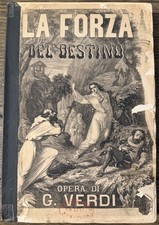
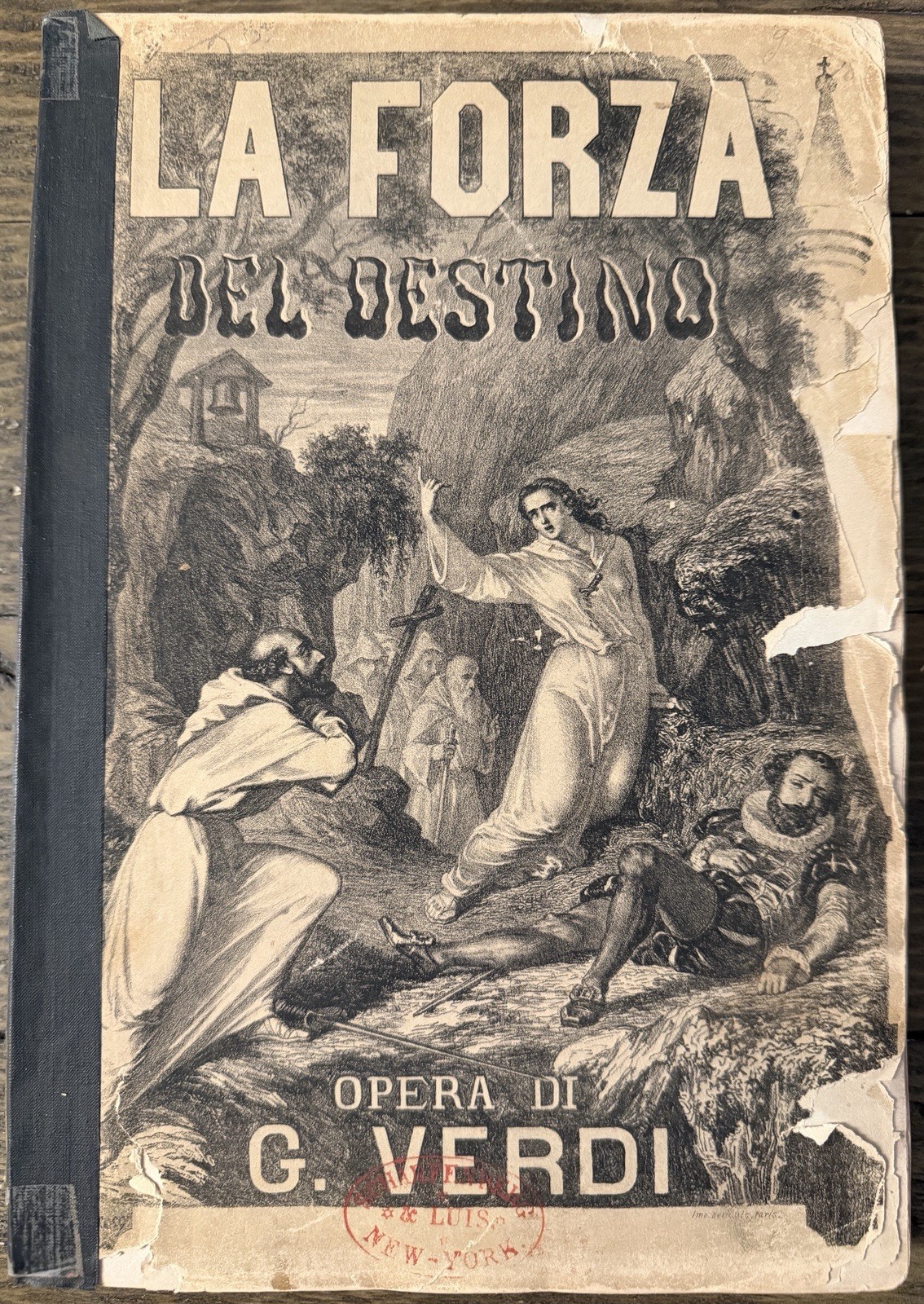
The elaborate illustrated front wrapper depicts the opera’s dramatic monastery scene and bears the imprint “Imp. Bertauts, Paris.” The rear wrapper contains an extensive Léon Escudier catalog of Italian and French operas, vocal scores, and piano arrangements. The first music page carries the printing credit of Charles Trinocq, 113 rue du Faubourg Saint-Martin, Paris.
Both the front wrapper and title page bear red oval stamps from Scharfenberg & Luis of New York, a nineteenth-century music importer and retailer specializing in foreign music. The stamp provides evidence that this Paris edition was imported into and sold through the American music trade during the nineteenth century. Scharfenberg & Luis operated in New York during the mid-nineteenth century and advertised imported foreign music from its Broadway premises. Scharfenberg & Luis catalog record
A blue signature-style “Léon Escudier” publisher’s mark appears on the title page. This should be understood as a publisher’s authentication or facsimile mark rather than represented as a personally signed autograph.
Condition is poor and structurally fragile. The original illustrated front and rear wrappers survive but have been extensively reinforced with later black cloth tape along the spine and hinges. The front wrapper has heavy rubbing, toning, staining, creasing, edge wear, numerous tears and chips, and substantial paper loss around the corners and right edge. Several torn portions remain partly detached or folded back. The rear wrapper has toning, staining, edge tears, creases, and a large loss at the lower-left corner, with older transparent tape repairs along the bottom edge.
The binding is substantially weakened and split internally, most notably between pages 32 and 33, where the text block has separated at the gutter. The black cloth spine reinforcement remains in place but should be regarded as an old repair rather than the original binding. Additional small patches and pieces of tape are present at the spine extremities. The page edges are heavily toned, uneven, worn, and curled, with scattered tears, chips, creases, staining, and occasional spotting. Some gatherings are loose or separating, and the score should be handled carefully to avoid further damage.
Despite the binding defects, the engraved musical notation and Italian text remain generally dark, clear, and readable. The decorative title page, original cast list, detailed musical index, first page of music, and final numbered page 322, ending with “Fine dell’Opera,” are present. Completeness has not been verified page by page. Offered as a fragile antiquarian score of particular interest to collectors of Giuseppe Verdi, early opera publications, nineteenth-century sheet music, and the original version of La Forza del Destino. Please review all photographs carefully as part of the condition description.



![Verdi / Callas,Maria - Verdi: La Traviata (1958 Lisboa Live) [New SACD] Bonus Tr picture](/store/img/g/3DEAAeSwQMZquX-F/s-l225/Verdi-Callas-Maria-Verdi-La-Traviata-1958-Lisboa-L.jpg)