When you click on links to various merchants on this site and make a purchase, this can result in this site earning a commission. Affiliate programs and affiliations include, but are not limited to, the eBay Partner Network.
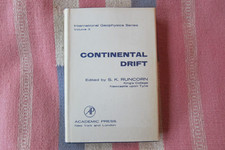
Stanley) Keith RuncornFRS[2](19 November 1922 – 5 December 1995) was a British physicist whosepaleomagneticreconstruction of the relative motions of Europe and America revived the theory ofcontinental driftand was a major contribution toplate tectonics.[2][3][4]
Education and early life
Runcorn was born inSouthport,Lancashire, and educated atKing George V Grammar SchoolandGonville and Caius College, Cambridge, whence he graduated in engineering within two years in 1942.[5]After a period inradarresearch during the World War II, he joined thePhysics Departmentat theUniversity of Manchesterwhere he did research on aspects of the Earth\'smagnetic field, taking hisPhDfor research supervised byPatrick Blackettin 1949.[1][6][7]
Career and research
Runcorn\'s PhD led to his interest inpalaeomagnetism, the study of the magnetism of rocks, which he pursued first at the Geophysics Department at theUniversity of Cambridgeand later atNewcastle University, where he was appointed to the chair of Physics in 1956. At Newcastle, Runcorn developed a strong research group ingeophysics, and made substantial contributions to various fields, including convection in the Earth and Moon, the shape and magnetic fields of the Moon and planets,magnetohydrodynamicsof theEarth\'s core, changes in the length of the day,polar wandering,continental driftandplate tectonics. After his retirement in 1988 he continued to be active in various lines of research until his untimely death in San Diego in 1995.
Awards and honours
Runcorn received many honours, includingFellowshipof theRoyal Societyin 1965, theGold Medal of the Royal Astronomical Society(RAS) and theFleming medalof theAmerican Geophysical Union(AGU).[8]He was also a member of thePontifical Academy of Sciences. In 1970 he was awarded theVetlesen Prize, widely considered the highest honor in geology.[9][10]In 1981, Runcorn became a founding member of theWorld Cultural Council.[11]He served as the Sydney Chapman Endowed Chair in Physical Sciences at the University of Alaska from 1989 to 1995. In 2007 the RAS named an award – for the year\'s best PhD thesis in geophysics – theKeith Runcorn Prizein his honour.[12]