When you click on links to various merchants on this site and make a purchase, this can result in this site earning a commission. Affiliate programs and affiliations include, but are not limited to, the eBay Partner Network.
Tentatively attributed to Operation TOMAHAWK — Munsan-ni, Korea — March 23, 1951
An arresting collection of black-and-white military photographs capturing the scale, height, and extraordinary visual impact of a mass parachute drop. Offered together with a newly created 13 × 19-inch historical companion print, this grouping combines the appeal of physical vintage photographs with a coordinated display piece.
These are images that reward a closer look: skies crowded with round parachutes, individual soldiers suspended beneath nearby canopies, fields and roads spread beneath the descending troops, clustered parachutes apparently carrying equipment, and a canopy caught among bare tree branches.
The strength of this group is its range of viewpoints. Some photographs convey the enormous scale of the drop; others bring the viewer much closer to the men descending toward the landing area. Together, they offer considerably more visual depth than a single isolated parachute photograph.
Historical Attribution: Operation TOMAHAWK
The group is tentatively attributed to the 187th Airborne Regimental Combat Team’s Operation TOMAHAWK assault at Munsan-ni on March 23, 1951. The documented operation formed part of Operation COURAGEOUS and sought to place airborne troops behind withdrawing enemy forces, establishing a blocking position near the Imjin River while an armored force advanced north to join them.
The proposed connection rests on the combination of mass personnel drops, apparent equipment drops, open agricultural terrain, surrounding ridgelines, and sparse vegetation. These features are compatible with documented Munsan-ni imagery, although none is unique enough to establish the location by itself. The National Archives photograph credited to Cpl. P. T. Turner provides a documented comparison from the operation—not an exact match to the photographs offered here.
The reverses are uncaptioned, with no identified photographer or unit credit. The photographic paper appears to be Velox-type, but its exact marking and production date have not been verified. Accordingly, this group is offered with a historical attribution, not documented battlefield provenance.
Could the Photographer Have Jumped with the Troops?
The camera positions make that an intriguing possibility.
Several views appear to place the camera among the descending parachutes, with nearby canopies at different heights and the landscape visible below. Those perspectives are compatible with photographs taken by a participating paratrooper, an airborne-qualified military photographer, or an accompanying correspondent.
There is a documented precedent: Luciano Carneiro, photographing for the Brazilian magazine O Cruzeiro, used his parachuting experience to jump with American troops during the Korean War. Instituto Moreira Salles preserves his work, including photographs specifically identified with Operation TOMAHAWK at Munsan.
That history gives meaningful context to the possibility of a photographer descending alongside the soldiers. However, some aerial views could also have been taken from an aircraft, while other frames appear ground-based. It has not been established that every photograph was taken by the same person or on the same day.
No authorship claim is made for Turner, Carneiro, or another named photographer. What the photographs do offer is a compelling visual impression of an airborne operation from several close and distant perspectives.
The Men and Units Behind the Operation
Operation TOMAHAWK brought together the 187th Airborne Regimental Combat Team—the Rakkasans—the 2nd and 4th Ranger Companies, and Indian Army parachute medical personnel. The 2nd Ranger Company also occupies a distinctive place in Army history as its only all-African American Ranger company. Both Ranger companies participated in the March 23 combat jump.
Lieutenant General Matthew B. Ridgway directed the operation as Eighth Army commander. Brigadier General Frank S. Bowen Jr. commanded the 187th and organized its airborne landing plan. Brigadier General John P. Henebry, commanding the 315th Air Division, was involved in the airlift planning. Their roles connected the assault’s ground objectives, parachute landings, and transport-aircraft effort.
Meanwhile, Task Force Growdon advanced north to link up with the airborne troops. The forces joined that evening, although the main enemy formation had already escaped the intended trap. Operation TOMAHAWK became the last large-scale airborne operation of the Korean War. These historical connections describe the proposed subject of the group; they do not identify particular individuals within the photographs.
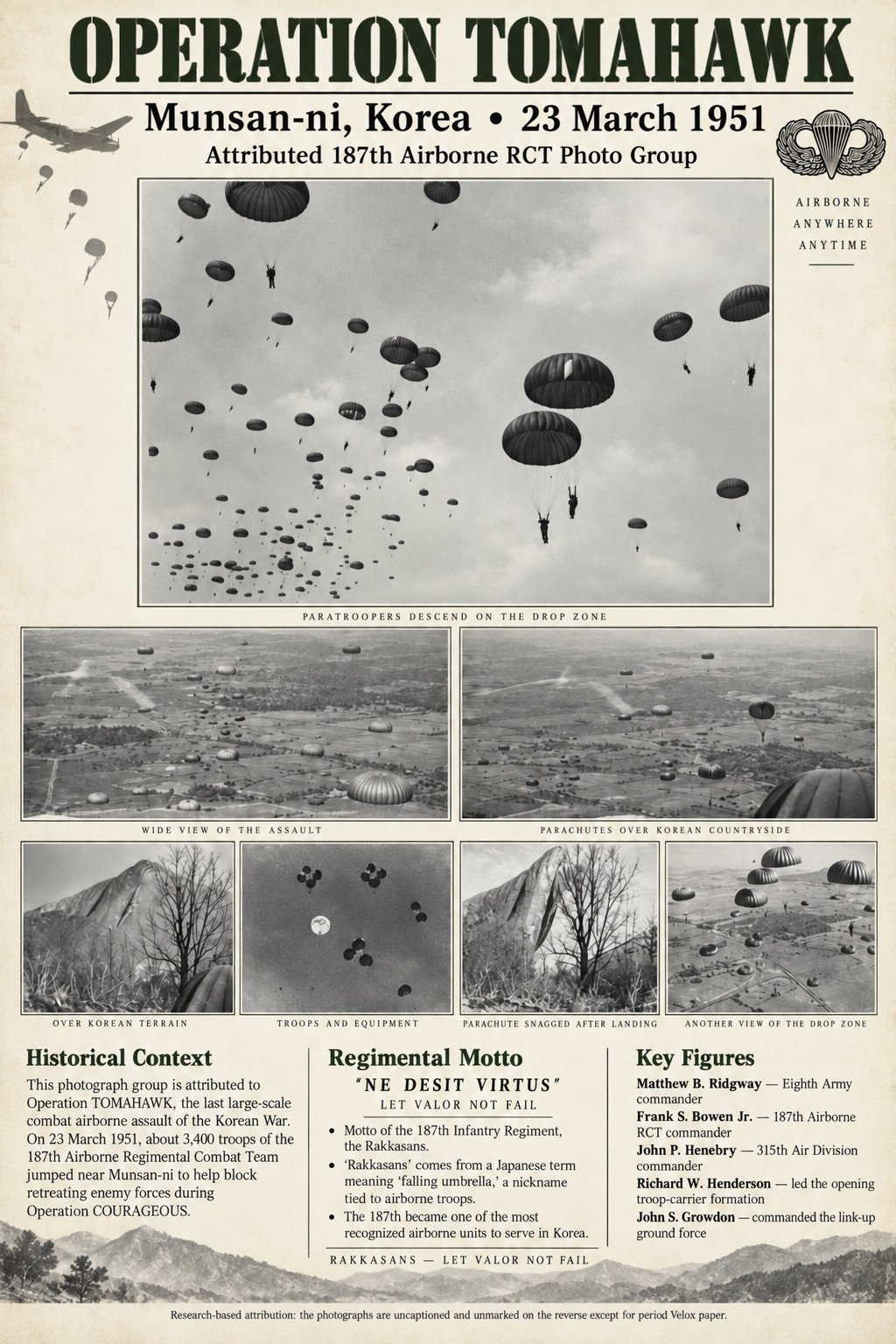
Included: Custom 13 × 19 Historical Companion Print
A newly produced, unframed 13 × 19-inch companion poster is included with the photograph group.
Created specifically to accompany this collection, the design presents OPERATION TOMAHAWK in a vintage military-history layout, combining a photographic-style collage with an aged-paper appearance, restrained dark lettering, historical context, and a section highlighting figures connected to the operation.
The design also features the Rakkasans’ regimental motto:
NE DESIT VIRTUS
LET VALOR NOT FAIL
The companion gives the collection a coordinated display element: a focal point to frame beside the photographs, or to display while keeping the vintage prints separately protected. It brings the proposed historical connection, imagery, and regimental identity together in one presentation.
The companion is modern, AI-assisted interpretive artwork based on the photograph group. It is not a wartime poster, an exact photographic facsimile, an official military publication, or a certificate of authenticity. Its inclusion does not authenticate the proposed attribution.
Condition
The vintage photographs show varying age and handling wear, including surface scratches and scuffs, creasing, curling, edge wear, and areas of toning or discoloration. Condition varies between photographs. Glossy surfaces also produce reflections in the listing images; please examine all photographs for the individual details.
The companion poster is a separate, newly produced print, supplied unframed.
The entire photograph group and the 13 × 19 companion print are offered together. A visually compelling pairing for an airborne-history collection, military photography display, or a collector interested in researching the story behind these images.