When you click on links to various merchants on this site and make a purchase, this can result in this site earning a commission. Affiliate programs and affiliations include, but are not limited to, the eBay Partner Network.
Word Feast-ElementaryLinda Bowers
- Format:BK
Ages: 7-10
Grades: 2-5
Teach the vocabulary that has the most potential to affect academic performance and expression. Robust vocabulary instruction builds word-learning strategies and helps students make the new words \"their own.\"
Robust vocabulary instruction focuses on the high-frequency words that apply to a variety of subject areas. These Tier 2 words (Beck, McKeown, & Kucan, 2002):
- appear frequently across a variety of subject areas.
- are not part of students\' day-to-day vocabulary.
- have rich meaning and connections to other words and concepts.
- add specificity and flexibility to students\' expression.
- easily link to other words students already know.
Two decades of research have shown this instruction method is most effective in advancing students\' vocabulary growth (Moore, 2011).
The substantive, seven page lessons in Word Feast Elementary use a consistent pattern of reading, thinking, and writing exercises. Each lesson progresses from comprehension to expressive activities and follows this sequence.
The activities progress from comprehension to expressive tasks and follow this sequence:
- introduction of new words and teaching tips
- questions to activate prior knowledge
- two to four reading passages
- word definitions with examples
- associations activity
- thinking activities like: Finish the Thought, Yes/No Questions, In Your Own Words, Antonyms & Synonyms, and more
The age-appropriate chapter topics such as Truth or Myth and Inventions Old and New are mostly curricular. The chapters progress in difficulty regarding general knowledge, readability, and word knowledge.
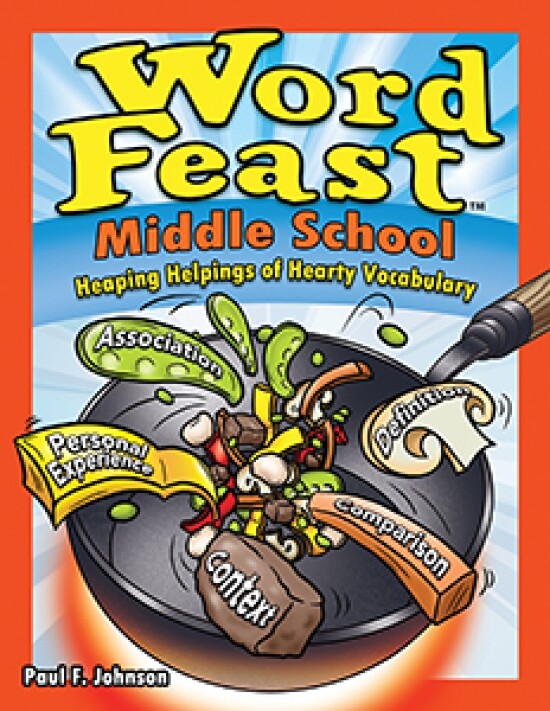
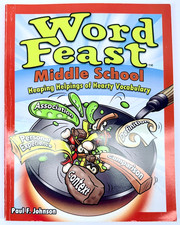
Word Feast-Middle School Paul F. Johnson
Ages: 11-14
Grades: 6-9
Power up middle school students\' vocabulary with words that have the most potential to improve learning, reading comprehension, and communication. This resource combines robust vocabulary instruction with topics sure to spark student interest.
Robust vocabulary instruction focuses on the high-frequency words that apply to a variety of subject areas. These Tier 2 words (Beck, McKeown, & Kucan, 2002):
- have rich meaning and connections to other words and concepts
- are used by mature language users
- add specificity and flexibility to students\' expression
- easily link to other words students already know
Two decades of research have shown this instruction method is most effective in advancing students\' vocabulary growth (Moore, 2011).
The book has 16 substantive, 7-page lessons. Each lesson teaches ten carefully-chosen vocabulary words. The vocabulary words are repeated in subsequent lessons. The lessons have a consistent pattern of reading, thinking, and writing activities.
The activities progress from comprehension to expressive tasks and follow this sequence:
- introduction of new words and teaching tips
- questions to activate prior knowledge
- one or more reading passages
- word definitions with examples
- associations activity
- thinking activities like: Finish the Thought, Yes/No Questions, In Your Own Words, Antonyms & Synonyms, and more
The age-appropriate lesson topics such as The Movies\' Mystery Man, Money Matters, and Arguments and Persuasion are mostly curricular. The chapters progress in difficulty regarding general knowledge, readability, and word knowledge.
- Word Feast-Middle School for Figurative Language Paul F. Johnson
- sku31266
Ages: 11-14
Grades: 6-9
For your students who interpret figurative language literally, ease their frustration and end confusion with Word Feast–Middle School for Figurative Language. Each expertly-crafted lesson is designed to demystify the interpretation and use of this colorful language.
Students with ASD and other language disorders misunderstand the communication intent of their peers which often leads to social segregation. The lessons in Word Feast Middle School for Figurative Language give your students access to understanding and using figurative language in their communication.
Based on best-practice techniques, each lesson centers on a theme and includes:
- targeted figures of speech
- teaching tips
- prior knowledge activation questions
- controlled-level, context-rich, and often hysterically funny reading passages
- teaching activities that include interesting facts about the history of the phrase
- a list of student-friendly meanings that include usage tips and correct/incorrect usage examples
- answer key
Lesson themes include On the Job, Fashion and Clothing, Music, Team Sports, Money, Nature, Fun and Games, and many others.
Give your students the language power they need to banter with their peers, write colorfully, and end their feeling of social isolation with Word Feast–Middle School: for Figurative Language.
Word Feast-Adolescent Paul F. Johnson • Linda Bowers sku31269
Ages: 13–18
Grades: 8–Adult
Robust vocabulary instruction is built into each powerful lesson uniquely designed for teens. Advance your students\' vocabulary skills by teaching high-frequency words in context.
Focus on high-frequency words that apply to a variety of subject areas and your vocabulary therapy will be exceptionally beneficial to your older students. These Tier 2 words (Beck, McKeown, & Kucan, 2002):
- have rich meaning and connections to other words and concepts
- are used by mature language users
- add specificity and flexibility to students\' expression
- easily link to other words students already know
Two decades of research have shown this instruction method is most effective in advancing students\' vocabulary growth (Moore, 2011). The book has 16 substantive lessons. Each lesson teaches ten carefully-chosen, Tier 2 vocabulary words. The vocabulary words are repeated in subsequent lessons. The lessons have a consistent pattern of reading, thinking, and writing activities.
The activities progress from comprehension to expressive tasks and follow this sequence:
- Teaching tips
- Activating prior knowledge questions
- Reading level-controlled, context-rich reading passages
- Student-friendly definitions that highlight proper usage tips and examples of correct/incorrect application in context
- Hands-on vocabulary activities that include Making Associations, Antonyms/Synonyms, Complete the Thought, Grammar and Usage Flexibility, Personal Experience
The age-appropriate lesson topics tackle curricular vocabulary and concepts and high interest, non-curricular topics such as Professional Athletes\' Salaries, How to be a Real Hero, Vegetarians, Peer Pressure, and Giving and Getting Advice. The chapters progress in difficulty regarding general knowledge, readability, and word knowledge.
o-4