When you click on links to various merchants on this site and make a purchase, this can result in this site earning a commission. Affiliate programs and affiliations include, but are not limited to, the eBay Partner Network.
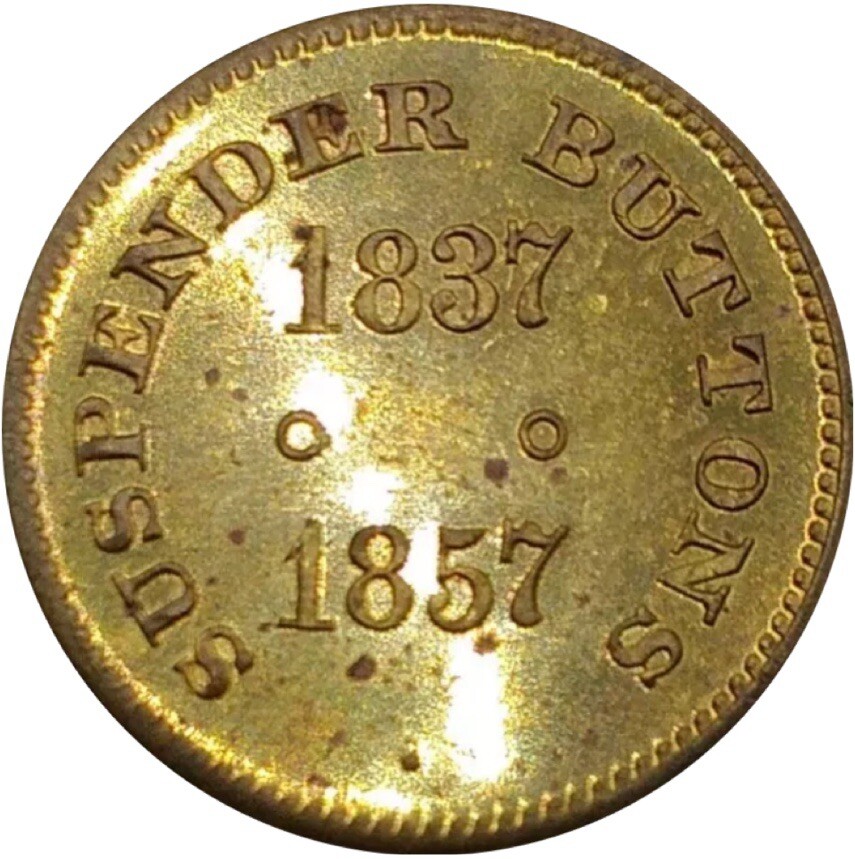
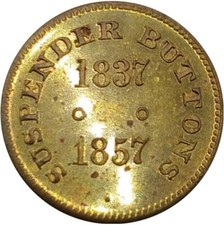
(1863) Aaron Whites Satirical Suspender Buttons Political Merchant Token. Struck by Aaron White of Connecticut. Stains. Unc Details. Plain Edge, 21mm, Brass.
During or shortly after the Panic of 1857, a political piece was issued which advocated a Drawing Together (Contrahendo) and Financial Solvency (Solvendo). This cause-related issue called attention to the suspension of specie payments by the federal government in that year by comparing this action to the events of 1837, when Andrew Jackson suspended specie payments. The analogy to Suspender Buttons may refer to the embarrassment that follows when one's suspender buttons fail. This piece may also have been issued as a reminder that specie payments were resumed following the Panic of 1837, and that specie payments would again be resumed following the Panic of 1857, just as suspender buttons can be restored. Inscribed on this piece is the word "Pun" indicating a play on words, and "Go. Sem. Par.," which has numerous meanings. Most obvious is "Go Semper," or always strive. Other possible interpretations include "good for a semi para" or good for half a minor Turkish coin; and "gobernacion sementis pars," or government by the planting region (i.e., the Southern plantation region of the United States).
The figure "2" with horizontal lines within the figure closely resembles the "2" which appeared on a number of contemporary 2 pennyweight pieces used in weighing metals. The use of such a "2" ties in with the "Two Cents" found on the preceding piece and with Aaron White's satirical piece of the same period by also referring to the superiority of hard money and to the low real value of paper money, "S.P." relates to "Sem Par" of the preceding piece, but probably had deeper implications."SP" probably refers to "Slave Power," a popular pro-Slavery rallying cry used widely in the Southern U.S. during this period. Politically and economically Slave Power had reached its zenith in the United States during the decade prior to the national election of 1860. Unlike the Eastern and Western states of the Union, which generally suffered during and in the aftermath of the Panic of 1857, the Slave States, with their reliance on cotton, were much more immune to the impacts of the collapse of financial markets on Wall Street of that year. In the wake of the Dred Scott Supreme Court decision of 1857, which declared that slavery could not Constitutionally be barred from the territories, the creator of this piece was not only advocating financial solvency, but also a drawing together (Union) under the leadership of the Slave States. When Abraham Lincoln stated his belief that the entire United States must eventually be either open to slavery or free of that institution, many Southern members of the U. S. Congress heartily agreed with him.
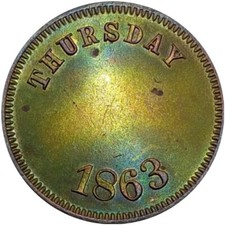
The response to this challenge by the Slave Power states did not come until January 1, 1863, a Thursday, when President Lincoln issued his Emancipation Proclamation. This proclamation freed all slaves within states which were in rebellion against the United States. A sequel and response to the Slave Power political issue of 1857 came in the form of another political token which employed the same obverse die used by the Slave Power advocates but which stated simply "Thursday / 1863" on the reverse. Placing emphasis on Thursday rather than January 1 had special significance. Traditionally Thursday is the day of Jupitor, the Roman God of Thunder. Consequently, the tone of this piece definitely was intended to resemble a thunderclap - a loud and violent denunciation of Slave Power.
A hoard inventory records:
* Aaron White’s token — SUSPENDENS
* 253 examples, including copper, brass and white metal
* separately, a brass CONTRAHENDO ET SOLVENDO token.
Y3G is a mule: the later Rulau classification pairs the Y3C CONTRAHENDO ET SOLVENDO obverse with an YNGENIO ECUADOR reverse. A modern investigation calls this an unusually confusing mule series.